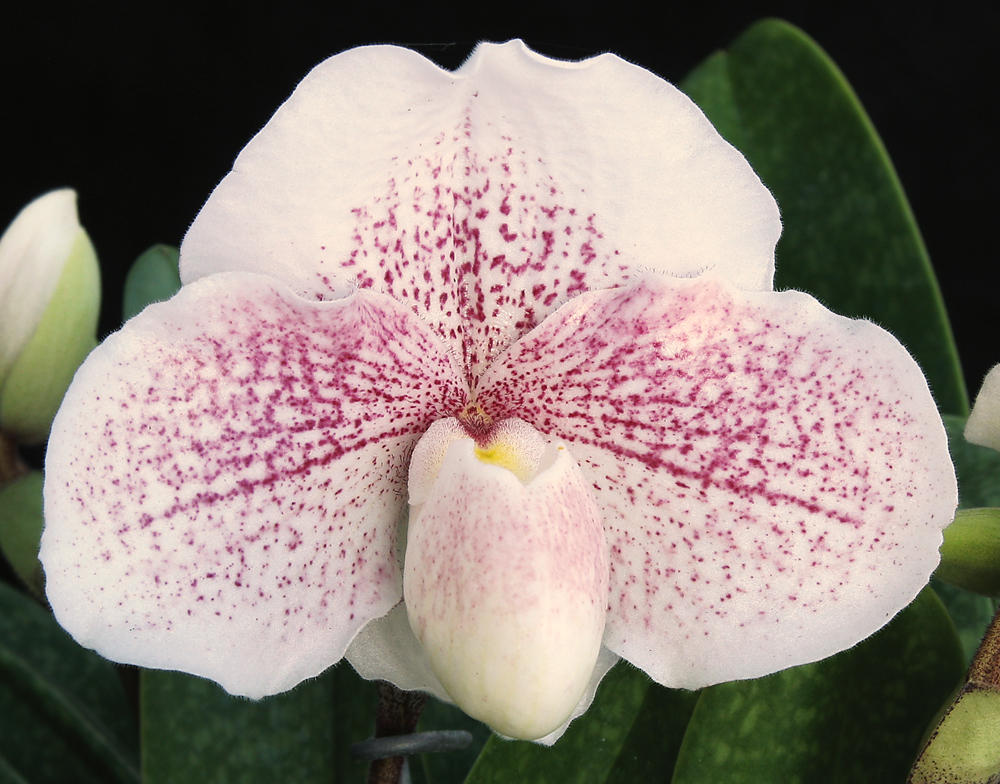
Just this
weekend, as I walked with my seven-year-old son on a hike into the
woods,
First, I noted that
P.Chardmoore, when
crossed with countless other complex paphiopedilums, had produced some
truly exceptional offspring. Unfortunately, only two or three were
outstanding; the rest were either mediocre or just plain abysmal. But
the great ones stood out both for their form and for the fine shape in
their progeny. In the white/pink complex, this was best exemplified by
the world-renowned P.Dusty
Miller, (F.C. Puddle x Chardmoore) bred by Ratcliffe Orchids. Out of the
many P.Dusty
Miller’s that were first flowered nearly 50 years ago, a scant few stood
heads above the rest. The most notable of these, from both a form and
breeding perspective, proved to be P.Dusty
Miller ‘Mary’ AM/RHS and P.
Dusty Miller ‘Dapple’ AM/RHS. Two other cultivars, ‘Bertsch’
At any rate,
P.Dusty Miller went on
to produce P.Miller’s
Daughter, a cross that was at the apex for form in white slipper
breeding for more than two decades.
Paphiopedilum Chardmoore has proved to be
such a fine parent since it was registered in 1927, that it is now in
the ancestry of nearly 1,750 crosses. A review of the crosses shows an
incredible group of names which span five decades, and are often at the
pinnacle of complex slipper breeding for their generation.
The second observation came from looking at the best in the white/pink
Paph. breeders that began gaining acclaim some 15 years ago at the
Orchid Zone in
At the same time that
P. Skip
Bartlett was gaining fame, I had the good fortune to acquire 80 to 90
seedlings of an unregistered cross of
Paphiopedilum(Silver Anniversary x Greyi).
Mrs. Linda Buckley had originated the cross in the later half of the
1980’s. The group contained several plants that were in bud, and I
decided to bloom a few before considering whether or not to sell any.
Two flowers opened at almost the same time, and I knew they were
special. The blooms were nicely tailored, with full well-rounded shape,
and excellent size for the parentage. Neither parent in the cross is
especially large, the natural spread of P.
Silver Anniversary being 9-9.5cm, and P.
Greyi being under 8cm. Nevertheless, virtually all of the offspring
would eventually prove to have flowers in the 10-11cm range.
I researched the lineage
of the cross in an effort to find the source of the large size, and
found that the pod parent, P.
Silver Anniversary, was one-half P.
Chardmoore. Once again, that famous old RHS parent was proving its
worth. Also interesting was the high percentage of brachypetalum
in the cross. Paphiopedilum
(Silver Anniversary x Greyi) had P.niveum
on both sides of its ancestry and P.
godefroyae from the
P. Grey,
reminding me very much of the brachypetalum
content in P.
Skip Bartlett. I compared this to a family tree of Skip Bartlett; its
high brachypetalum
makeup was with niveum,
bellatulum, and
godefroyae. I
put facts together and arrived at an important conclusion: the cross had
P. Chardmoore
in its close ancestry, a proven parent for quality and size; and, it had
a high brachypetalum
content that resembled P.
Skip Bartlett. These two facts led me to break away from conventional
white/pink slipper breeding, and to pursue a different breeding
direction that did not have P.
F.C. Puddle
in the ancestry.
Paphiopedilum F.C. Puddle was, at that time,
in the background of virtually all of the most well known white/pink
complex slippers. With this decision, the road to conventional breeding
wisdom ended. I registered the cross as P.
White Legacy with the RHS in 1993… and so
the adventure began.
***(Cynthia, sometimes brachypetalum is in italics in this paragraph,
and sometimes it’s not. Is this correct? Additionally, it is in italics
throughout a later section.)
I made several key
decisions when I started hybridizing with
P. White Legacy. I had noticed that in the
blooms of the original 80+ plants, only a few blooms were without some
sort of pouch notches or asymmetries, varying from minor to major
imperfections. So I decided to make a sibling cross with two of the
P. White
Legacy cultivars that showed little or no pouch problems.
Next, I chose to cross
P. White
Legacy with many of the parents that already had been successfully
paired with Skip Bartlett ‘White Pepper’
We now jump forward nearly
a decade, to the present… and can finally see what my adventure into the
world of P.
White Legacy has brought. The offspring of this wonderful parent have
produced much of what I had hoped for, and it has been a joy to see the
beauty within its breeding lines. I would like to share the breadth and
depth of what P.
White Legacy breeding offers. We will look at the
unusual color combinations, tones, patterns and markings, and see the
remarkable form, from standard to novelty types.
The variability of colors
and combinations within a given grex is one of the great surprises that
I see quite often in P.
White Legacy crosses. The same cross can produce a wide range of colors,
varying from white with pastel pink overlays and no spotting, to rich
raspberry pink petals and spotting on the dorsal sepal. One cross that
shows this broad range is P.
Winter Star (Starr Dust x White Legacy). The parent
P. Starr Dust
originated from a flask of seedlings from Mr. Lester Ng, and he
registered the grex in 1989. It was a full pink and white flower from
P.
Freckles by P.
Personella. He was therefore combining a flower that was primarily white
with an almost solid red parent. Pinks crossed to reds will generally
yield a predominance of medium to deep pink offspring, and this was the
case in P.
Starr Dust. When I crossed this plant to P.
White Legacy, I hoped for flowers that were even fuller than
P. Starr Dust, and in
a wider range of color tones. The concept was that by “double dosing”
with white genetic material, both parents being white/pinks, I could see
better dominance of white in the progeny. There was indeed an excellent
variety of colors and patterns in this remarkable cross.
Paphiopedilum Winter
Star also produced exceptional form.
While the color
combinations within a given cross can be highly variable, the
variability when looking at different crosses is even more pronounced.
Two of the most remarkable color groups to appear, have done so just
this past bloom season; they are desirable for both their unique colors
and the pleasing arrangement of those colors. These new crosses have yet
to be registered. The first is P.
Ruth Wright by P.
White Legacy, made in 1998 and grown from flask since late 2000. I chose
to breed with P.
Ruth Wright, as it is one-half P.
Hellas, but boasts a far larger flower of 13cm natural spread and has
6.5cm wide petals. The very first cultivar to bloom, ‘Fantasy’, flowered
on a 25cm (10 in.) one-growth seedling, with a flower over 11 cm across!
Furthermore, the flower displayed startling color combinations; the
background color consisted of an icy pastel yellow/green, a unique
cinnamon pink petal and pouch overlay, and was crowned with a bold
raspberry/chocolate flame up the dorsal sepal. When I saw this flower in
bloom for the first time, the name ‘Fantasy’, was my first thought.
Another sibling to this plant flowered out about two months later, with
very different color combinations, but equally striking. That cultivar
was predominantly a pretty cream/white and pastel pink color, but with
bold overlays of mulberry flairs on the petals and raspberry/chocolate
striations on the dorsal sepal. The name ‘Moonbeam’ was chosen, alluding
to the full moonlike form and radiating color burst markings.
A second cross
demonstrates one of the most striking colorations that I have seen thus
far from P.
White Legacy. It is a pairing of P.
Lunacy and P.
White Legacy, whose unique beauty comes from the color placement. It is
essentially a pure white flower with an unusual rose-pink overlay on the
petals, and a dark rose suffusion at the very base of a clear white
dorsal sepal. When I first saw this plant in bloom, it appeared as if a
pink butterfly had landed on a white flower, so I named it ‘Butterfly
Kiss’. The cross is at present still unregistered.
As I have flowered
out more crosses from P.
White Legacy in recent years, an unusual color has surfaced with
reasonable frequency. The colors fall into a range of what I refer to as
cinnamon pinks, a color that I have seen only rarely prior to
P. White Legacy
breeding. One of the most consistently well-formed crosses to bloom,
that also yielded a good number of cinnamon pinks, is
P. White Legacy with
P. Amandahill.
It is no surprise that P.
Amandahill has produced fine form in its offspring, as its parents are
P. Amanda and
P. Winston
Churchill. But it is the blended genetics with
P. White Legacy that
gives rise to a wonderful mix of brushed or spotted rich cinnamon pinks.
The cultivars ‘Rosy World’ and ‘Rose Mist’ are fine examples of this
line of breeding. P.
Sylvan Moon is another high quality cross that has produced cinnamon
pinks in rich bold colors. Once again, P.
White Legacy was combined with a large dusky-toned red… the quality
breeder P.
Sylvan Vale ‘Sparsholt’. The result was very full boldly colored
flowers, represented well by the beautiful
P. Sylvan Moon ‘Dreamscape’. In an effort to
produce softer pastel pinks, I tried a different approach by crossing
P. White Legacy
with amber-colored parents instead of reds. The thought was that if
crosses to reds produced darker pinks, crosses with ambers should
produce lighter pink colors. One of the prettiest hybrids of this type
is Papaiopedilum
White Galaxy (Memoria Jack
Among the best
qualities coming from P.
White Legacy are the wonderfully unique patterns and markings that the
flowers so often display. The following serve to show some of the more
extreme examples of this. Paphiopedilum
White Galaxy ‘Pastel Moon’ was one of the
more subdued examples of this cross. A more radically marked offspring
of the same cross is P.
White Galaxy ‘Mystery Lady’. This flower is 12cm across, and boasts an
intriguing array of both light and vibrant darker pink over a cream to
white background; all are combined through brushed tones, striations,
and spots. The flower gives us the perfect image of a “Mystery Lady.”
Moving in a very different, but equally mesmerizing, direction is a
boldly speckled flower called P.
Great Expectation ‘Moonstorm’, the progeny of
P. White Legacy by
P. Skip
Bartlett. Most of the grex were lightly stippled whites, but ‘Moonstorm’
displays what might be called very small spotting (or large speckling)
throughout. I hope to be able to advance this type of flower into large
pure whites with even larger spotting across the entire flower. One
wonders… if P.
White Galaxy ‘Mystery Lady’ and P.
Great Expectation ‘Moonstorm’ were combined, would
we get what might be called a ‘Mystery Storm’… a flurry of large
speckles across the entire flower?
Flower form is at
the top of any hybridizer’s list of important qualities in offspring.
This key element makes or breaks many crosses, and is essential to the
success of P.
Skip Bartlett ‘White Pepper’
Another cross of
exceptional form that just bloomed a few months ago is
P. Amanda with
P. White Legacy, as
yet unregistered. The image shown gives a scale to reference the overall
flower dimensions. The blooming was on a small single growth plant. It
is reasonable to expect that the flower will top the 6cm wide petal mark
on a larger multi-growth plant. In the more white, as opposed to
pink-tones, P.
Arctic Ice has produced some well-formed progeny.
Paphiopedilum Arctic
Ice ‘Perfection’ AM/
When I first ventured out
in new directions for P.
White Legacy, novelty lines seemed to hold great potential. Two of the
best crosses to bloom out resulted from using some brachypetalum
species; specifically P.
godefroyae v.
leucochilum and
P. bellatulum. The
P. godefroyae
cross, registered as P.
Dust Storm, yielded several nice cultivars. Two received
Perhaps a more radical
novelty cross was P.
Fairy Lace (P.
White Legacy x P.
fairrieanum). My logic in trying this pairing was fairly
straightforward. Most of the crosses that I had seen bloom from
brachypetalum species by P.
fairrieanum were quite nice; they tended to have much better flower
spikes, coming from the P.
fairrieanum, and lovely rose webbing on ruffled petals. Considering the
high brachypetalum content of P.
White Legacy, I believed I might get similarly pleasing flowers. The
cross, indeed, bloomed out much like the
brachypetalum lines, but with substantially
longer stems and far larger flowers. Three flowers have been awarded
thus far, and P.
Fairy Lace received an AQ/
A final area of interest
in breeding centered on crossing P.
White Legacy with other complex whites. When I first began to bloom out
P. White Legacy
lines, the dominance for pink tones in the offspring became apparent. In
crossing to greens or golds, I could achieve quite large flowers, but
only a low percentage had exceptionally white background color. With
this goal in mind, I decided to try and cross P. White Legacy to other
nice white parents. In 2002 I began to bloom out
In crossing
P. White Legacy to
whites, however, one grex stands above the rest. Nearly eight years ago,
in 1998, I crossed P.
Skip Bartlett ‘White Pepper’
My closing thoughts go back now to “…where the road ends, the adventure begins!” In my early white/pink hybridizing efforts, I stepped off the conventional road of slipper orchid breeding… and into a world full of new colors, patterns, and shapes. I will continue to create and explore new worlds, for only in doing so can new discoveries be made. And I hope that as I do, others will enjoy seeing what I discover along the way. The beauty of entering a new world is that when we walk through it, we leave our own footprints as we go. A new path develops in this world that, perhaps, others will one day follow. And it’s a good thing, for there are far too many worlds for just one person to explore!
Hadley is available to
speak to Orchid Societies & at Shows.
If you would be interested in having him speak,
please contact us for availability.
Greenhouse:
(336) 644-7085 Cell: (336) 655-5883